About Dr. Brownell
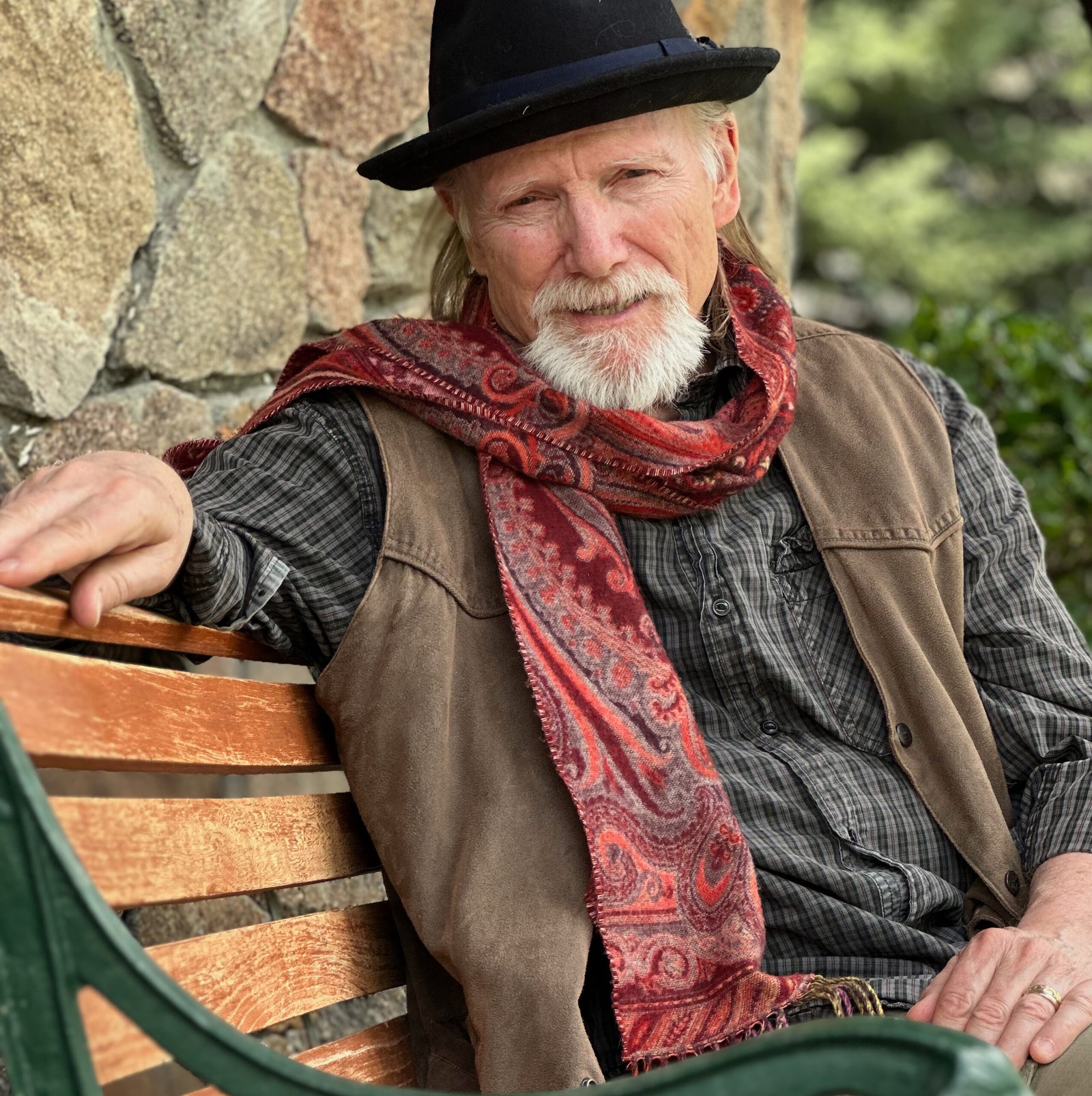
Philip Brownell, MDiv, PsyD
I am a clinical psychologist. I have been working with people in one capacity or other, from line staff at psychiatric hospitals and co-occurring treatment centers, from child and adolescent treatment programs and therapeutic schools, in community mental health or private practice, for over fifty years. I have taught psychotherapy, supervised students, written books and articles in professional journals, presented at major international conferences, and led colleagues in research-focused teams in various parts of the world. I’ve also been a pastor and helped people grow in the knowledge of God. I’ve dealt with the difference between dead religion and living spirituality. I’ve had to unravel the knot of spiritual deception and the trauma of spiritual abuse. I have also learned from others–my patients, my colleagues, and friends. Please contact us if you would like to explore the possibilities that are available.
A Few Things We Are Really Good At

Psychotherapy
I am a trained Gestalt therapist. My practice is grounded in Contemporary Gestalt Therapy, and my application of it is a holistic and relational approach. I assimilate elements from Acceptance and Commitment Therapy and also utilize Mindfulness-based, Inter-generational Family Dynamics, Somatic considerations, Behavioral Experiments and other strategies as appropriate.
As an expression of my clinical understanding, I have written the following three books: Gestalt Therapy: A Guide to Contemporary Practice, Gestalt Therapy for Addictive and Self-Medicating Behaviors, and Gestalt Psychotherapy and Coaching for Relationships.

Professional Coaching
I am a certified professional coach, having graduated from a training program accredited by the International Coaching Federation (ICF) through the school of business at Duquesne University, and I am a co-editor of the text Professional Coaching: Principles and Practice. I use coaching methodology myself, and I also partner on occasion with another certified professional coach and peer support specialist when the situation calls for it.

Spiritual Formation
I have a Master of Divinity from Western Seminary, and I spent thirteen years in full time ministry. My specialties are the integration of Christian spirituality and psychotherapy, spiritual formation, and the healing from spiritual abuse.
I am the author of Christianity and Gestalt Therapy: The Presence of God in Human Relationships and Spiritual Competency in Psychotherapy, both provide resources for psychotherapists working with people of spiritual faith. I am also the author of the forthcoming book (due out in early 2027) titled A Gestalt Therapist Teaches in Ukraine: Post-Secular Psychotherapy in a Difficult Field.
Dr Brownell is adept at psychological and neuropsychological assessment (testing)
“I spent the last ten years offering testing to the Twin Falls and surrounding areas through an integrated health system. Now, I would like to offer the same service but without the need for time consuming pre-authorizations and frustrating limits to clinically needed assessment instruments and processes often encountered with insurance companie. Using technology not previously available, and offering a sliding scale, we can reduce the time and the cost often encountered with such testing.”
Commmon assessments include ADHD testing for children and adults, screening for autism spectrum disorder in children and adults, evaluation of psychological and/or personality disorder, and assessment of intellectual ability. The initial brief consultation, to see if we can help, is free.
Some Practical Things You Will Need to Consider
I am an out of network provider. I do not take insurance, but I will give you a “Superbill” with which you may be able to obtain reimbursement from your insurance company. I have chosen not to be on insurance panels in order to devote my time and energy to my patients and the work we do together rather than filling out forms and trying to deal with the shaping influence that insurance companies exert over therapists.
Available in 43 States
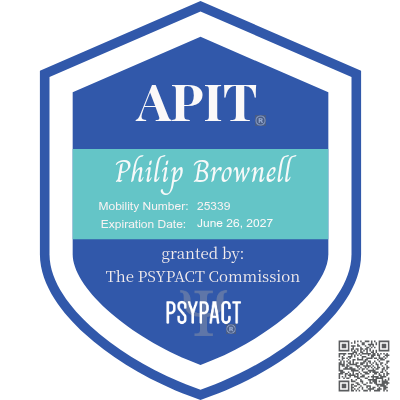
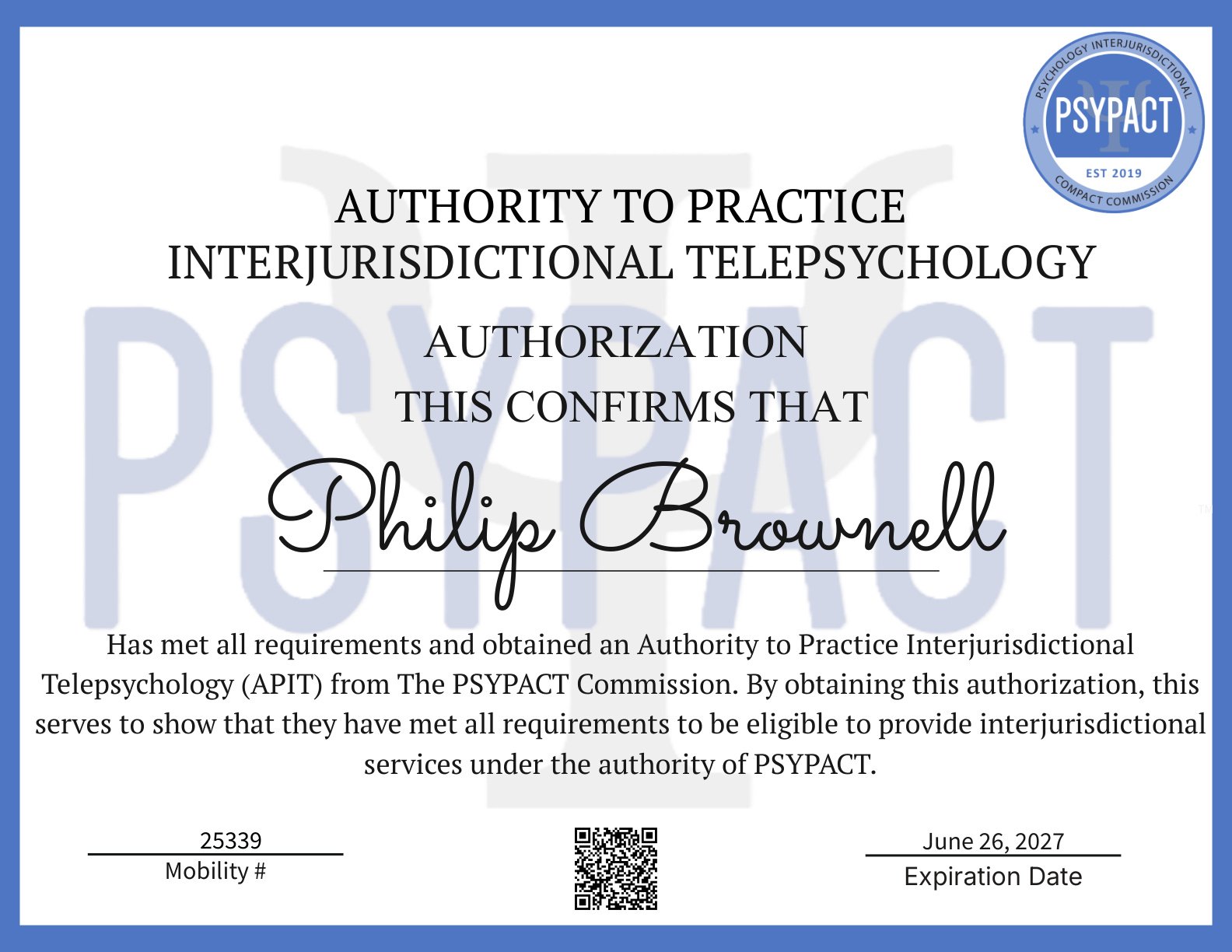
I am qualified to work in forty-three states if meeting in the online environment. Currently, that includes UT, NV, CO, WY, WA, and MT.
Fees and Payments
Standard individual psychotherapy sessions are 45-50 minutes in length, unless structured otherwise in advance.
Financial Responsibilities: The standard fee per session is $200 for individual / $250 for conjoint therapy. Psychological and Neuropsychological testing is calculated by the hour, by time, rather than CPT code (but CPT codes are included in the superbill). The fee is $200/hour for psychological and $250/hour for neuropsychological testing. Fees are due at the time of service. Payment methods (such as credit cards or HSA cards) are securely captured and processed via the practice platform.
Cancellation Policy: Consistency is foundational to relational therapy and timely progress in testing. If you must cancel or reschedule an appointment, you are required to provide at least 24 hours’ notice through the portal or via email. Cancellations made with less than 24 hours’ notice, as well as missed appointments, will incur the full session fee, except in verified emergencies.
Your privacy and the confidentiality of our clinical relationship are strictly protected by law and professional ethical codes. Information regarding your treatment will not be disclosed to any third party without your written consent. Clinical records are stored securely on an encrypted, HIPAA-compliant practice management platform.
Legal and Ethical Exceptions to Confidentiality: — I am legally mandated to break confidentiality under the following specific circumstances:
— If there is a reasonable suspicion or evidence of abuse, neglect, or exploitation of a child, dependent adult, or vulnerable elder.
— If you present an imminent risk of serious physical harm to yourself or to an identified individual. In such instances, I am required to take protective clinical or legal actions.
In response to a legally valid court order issued by a judge.
How Therapy Actually Works
Psychotherapy is an active process that requires vulnerability, curiosity, and investment. The benefits can be significant: improved self-acceptance, integrated emotional expression, greater clarity in personal boundaries, reduction in distressing symptoms, and a deeper sense of personal agency and relational fulfillment.
However, expanding awareness involves inherent risks. As you lean into unexamined parts of your experience, you may endure temporary increases in emotional discomfort, anxiety, sadness, anger, or physical vulnerability. Relationship dynamics outside of therapy may shift as you establish clearer boundaries or modify long-standing behavioral patterns. These developments are a natural, non-linear part of deep therapeutic integration. We will work collaboratively to pace our sessions in a way that respects your internal capacity.
To support a seamless and confidential client experience, this practice utilizes a secure, HIPAA-compliant portal for health records, scheduling, communications, and billing.
Client Portal: You will be provided access to a private client account. Please use this portal as your primary tool for secure messaging, document sharing, and scheduling modifications. That portal is best for coordination of care, supporting the more in-depth work in our sessions.
Telehealth Sessions: If we engage in remote video sessions, they will be hosted via the practice’s integrated, encrypted video platform. It is your responsibility to ensure you are in a quiet, private space with a stable internet connection to preserve confidentiality. This extends to any online administration of testing instruments.
Text and Email: Standard SMS text messaging and standard email are not inherently secure channels. I will not respond to anything coming to me that way. Clinical disclosures should be reserved for our secure portal or synchronous sessions, and alerts such as “running late.”
I am currently taking new patients on a limited basis. Please contact us.

CONTEMPLATION
The Online Journal of the Brownell Center for Psychotherapy and Growth

Psychotherapy or Counseling?
Psychotherapy explores chronic, deep-seated emotional and mental health issues, often stemming from past experiences. It is more concerned with identifying the “how and why” behind a challenge to effect a lasting personality or behavioral change. Counseling focuses on resolving specific, immediate issues or life challenges, such as stress management, career problems, or divorce. It is generally more immediate and task oriented. Those who practice psychotherapy often find themselves engaged in counseling as well because that is the kind of thing that often brings a person to seek help (only to discover later that it is related to something more). Counseling lends itself to a solutions-focused approach that is similar to coaching because both identify a positive future and attempt to find a way to get there. The problem facing many people, however, is that they have already attempted that only to find themselves doing the same thing over and over, matching themselves with the same kinds of people, getting into similar kinds of conflicts, dumping their mood into a familiar pit over the same kinds of issues and worrying about the same kinds of outcomes. That pattern suggests a way of life learned at an early age, and that kind of thing requires psychotherapy.
Psychotherapy and counseling can both use well established and proven approaches such as Acceptance and Commitment Therapy, Emotion Focused Therapy, Third Wave and Mindfulness Cognitive Processing, Relational Systems Psychoanalysis, and Contemporary Gestalt Therapy. At The Brownell Center we are committed to a relational approach that is sensitive to the unique pacing that is needed for each person. We are not interested in check-box mental health. We are interested in helping people release the knots in their lives that have formed over years of pulling as hard as they can at both ends of a situation.